Profile
Corrosion Risk Management in HVAC-R
In HVAC-R design, coil corrosion is best treated as a risk management problem. The risk is defined by two variables engineers deal with every day:
- Likelihood of corrosion occurring – driven primarily by the environment
2. Consequence if corrosion degrades performance or causes failure – driven by plant criticality
Where both variables are medium or high, corrosion protection stops being a maintenance preference and becomes a design control. Blygold appears repeatedly in specifications at exactly this intersection. Its global use is strongly correlated with known corrosive environments and HVAC plant whose failure has unacceptable operational consequences.
The sections below set out the main corrosion risk scenarios encountered in practice, supported by specific case examples.
Coastal and Marine Environments – Chloride-driven corrosion of air-cooled heat rejection plant
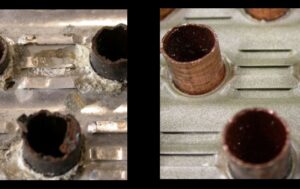
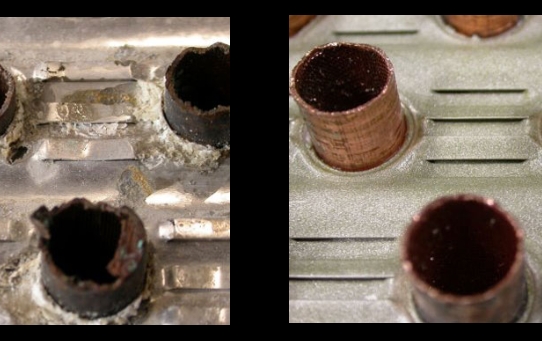
Chloride-driven corrosion is one of the most predictable failure mechanisms in HVAC-R. Salt aerosols deposit on aluminium fins, concentrate during evaporation, and initiate pitting corrosion. The presence of copper tubes accelerates damage through galvanic coupling. On exposed rooftops and plant decks, this process is continuous.
The HVACR plant most affected in these environments is predominantly air-cooled. Engineers regularly encounter severe fin degradation on air-cooled chillers, VRF and VRV condenser banks, packaged rooftop units, and dry coolers located within a few kilometres of the sea.
Blygold has been applied extensively to this category of plant on waterfront developments in the Middle East, including Burj Khalifa in Dubai, where it was applied to air-cooled chiller condenser coils exposed to a combination of marine air, desert dust, and extreme temperature cycling. It has also been used across Palm Jumeirah developments, where Blygold has been applied to large VRF outdoor unit banks and rooftop condenser coils serving residential and hospitality buildings located directly adjacent to the coast.
In island and near-shore resorts, including sites such as Daydream Island in Australia and comparable Caribbean and Pacific Island developments, Blygold has been applied to packaged rooftop units, split-system condensers, and chiller condensers to arrest fin loss that had previously led to early plant replacement.
Urban Pollution and Industrial Atmospheres – Acidic corrosion and long-term performance drift
In dense urban centres and industrial regions, corrosion tends to be less visually dramatic but equally damaging over time. Sulphur dioxide, nitrogen oxides, and fine particulates combine with moisture to form acidic films on coil surfaces. These films attack aluminium fin edges slowly, leading to progressive loss of effective surface area.
The HVAC plant most commonly affected includes rooftop air-cooled chillers, AHU cooling coils handling high outside-air fractions, and heat rejection equipment serving transport and civic infrastructure.
At London Heathrow Airport in the United Kingdom, Blygold has been applied to air-cooled chiller condensers and AHU cooling coils serving terminal buildings. These systems are exposed continuously to vehicle emissions and aircraft exhaust, with corrosion presenting as gradual loss of thermal performance rather than sudden failure.
Similarly, at Amsterdam Schiphol Airport in the Netherlands, Blygold has been used on air-side heat exchangers, including condenser coils and AHU coils, to stabilise long-term capacity in a highly polluted operating environment.
On large European governmental and civic buildings in dense urban centres, Blygold has been applied to rooftop chiller condenser coils to mitigate long-term efficiency drift caused by atmospheric pollution.
Data Centres and Mission-Critical Cooling – Corrosion as a redundancy risk
In data centres, corrosion risk is inseparable from redundancy risk. Cooling systems operate continuously and redundancy strategies assume that each unit will perform consistently over time. When corrosion affects all duty and standby plant simultaneously, redundancy margins erode in parallel.
The plant typically treated in this sector includes air-cooled chillers, adiabatic coolers, dry coolers, and associated condenser coils forming part of N+1 or N+2 design.
Blygold has been applied to condenser coils and dry coolers at European data centre campuses operated by providers such as e-shelter in Germany and Evoswitch in the Netherlands. In these facilities, the focus is not simply extending asset life, but maintaining predictable cooling capacity across the entire plant fleet.
Hospitals and Healthcare Facilities – Sustaining operability under continuous duty
Hospitals present a combination of moderate to high corrosion probability and high consequence of failure. HVAC systems operate continuously, often with high outside-air fractions and limited shutdown opportunities. Plant replacement is disruptive, and failure can directly affect clinical operations and infection control.
Air-cooled chillers and AHU cooling coils serving hospitals are frequently installed on rooftops or in exposed plant areas.
Blygold has been applied to chillers and AHUs at major European hospitals such as the Academic Medical Center in Amsterdam and UMC Utrecht. In many cases, existing coils were refurbished and protected in situ, allowing hospitals to extend plant life without large-scale replacement.
High-Humidity and Aquatic Facilities – Continuous wetting as a corrosion driver
Aquatic centres, pool halls, and high-humidity buildings create conditions where corrosion probability is inherently high. Continuous moisture films, elevated humidity, and chemically aggressive air accelerate oxidation and microbial-assisted corrosion.
The plant most affected includes AHU cooling coils and dehumidification coils serving pool enclosures and spectator areas.
Blygold has been applied to such coils at large aquatic and sports facilities, including the Gold Coast Aquatic Centre in Australia, where continuous wetting is unavoidable.
Water-Side Corrosion in Water-Cooled Plant – Hidden failure modes
Not all critical corrosion occurs on the air side. In water-cooled chillers and process heat exchangers, galvanic corrosion, erosion at tube inlets, and pitting of tube sheets can progress out of sight until leaks or failures occur.
Blygold water-side systems have been applied to chiller waterboxes, tube sheets, and industrial heat exchangers in power stations and heavy industrial facilities, including Stanwell Power Station in Australia and Limbe Power Station in Cameroon.
Offshore, Marine, and Defence Applications – High probability, high consequence
Offshore platforms, naval bases, and marine vessels represent the upper end of the corrosion risk spectrum. Continuous salt spray, high humidity, and limited access combine with extremely high consequences of failure.
Blygold has been applied to HVAC units on offshore oil and gas platforms, chillers and AHUs at naval installations such as Pearl Harbor and North Island Naval Air Station, and HVAC systems aboard large marine vessels.
Engineering Perspective
Across all these examples, the logic is consistent. Blygold is specified where the environment makes corrosion likely and the criticality of the HVAC plant makes degradation unacceptable. In this context, corrosion protection is not an optional enhancement but a rational risk control embedded in the design.
For engineers, Blygold functions as part of a broader corrosion risk management strategy, enabling HVAC-R systems to perform as designed throughout their intended service life in environments that actively degrade unprotected equipment.
Reviews
Comments are closed.