
Profile


Why it happens, how it maps to corrosion categories, and how Blygold helps prevent it
Airports are one of the harshest “built environments” for HVAC equipment in Australia because they combine coastal salt, industrial-type air pollution, high UV/heat, and constant wet–dry cycling. For heat exchangers (VRF condensers, air-cooled chillers, DX and refrigeration condensers, AHU coils), that combination drives rapid pitting, fin loss, galvanic attack, coating breakdown, and premature leaks—often years earlier than designers and owners expect.
This article explains the corrosion mechanisms specific to airports, how they align with Australian atmospheric corrosivity categories, and where Blygold coil coatings fit as a preventative control.
Why airports behave like “industrial atmospheres” (in practice)
Australian corrosion guidance classifies environments by what the atmosphere is doing to metal (salt deposition, pollutants, moisture/time-of-wetness, and cycling), not by whether the site is labelled “airport.” Airports replicate the same drivers used to define high corrosivity because:
1) Jet exhaust creates an industrial pollutant load
Aircraft/airport emissions include NOx, SOx, VOCs/unburnt hydrocarbons, and soot/particulates. When these deposit on metal surfaces and later get wetted by dew/rain/sea mist, they form acidic, conductive surface films and promote under-deposit corrosion.
2) Coastal chloride exposure is common for Australian airports
Many major airports are coastal (or in salt-influenced wind corridors). Chlorides are the big accelerant for HVAC because they promote pitting corrosion (especially aluminium) and greatly increase electrolyte conductivity.
3) Wet–dry cycling is constant
Aprons and terminal roofs see repeated night dew → daytime bake-dry → re-wet cycles. This concentrates salts and pollutants on the coil face and in crevices, keeping corrosion “re-armed” rather than washed away. (This is one of the main reasons airport HVAC often corrodes faster than a typical CBD rooftop.)
4) Australia adds UV + heat as multipliers
High UV and heat accelerate coating breakdown, embrittlement and micro-cracking—opening pathways for under-film corrosion.
What corrodes first on airport HVAC (and why)
- A) Condenser coils: VRF, air-cooled chillers, DX and refrigeration packs
Most air-cooled condensers are copper tubes + aluminium fins. That’s efficient, but corrosion-sensitive:
- Aluminium fin pitting and edge attack: chlorides + time-of-wetness initiate pits; fins thin and crumble → reduced heat transfer area and airflow changes.
- Galvanic effects at Cu–Al interfaces: once a conductive film exists (salt + acidic moisture), galvanic driving forces increase local attack.
- Under-deposit corrosion: soot + hydrocarbon film traps salts, keeping the coil face wet longer.
- Casing/base corrosion: fasteners, guards, base pans and coil frames corrode where water ponds or deposits accumulate.
Operational consequence: corrosion is not just cosmetic. It drives capacity loss, head pressure rise, compressor stress, and energy penalty long before a leak occurs.
- B) AHU coils (cooling coils, precool coils, energy recovery coils)
AHU coils near apron-facing OA intakes see similar pollutant deposition. In addition, AHU coils create their own corrosion condition:
- Condensate is present by design → long time-of-wetness.
- Any chloride/pollutant in the air stream dissolves into condensate → conductive film.
- Coil casings and drain pans become corrosion initiation points if not detailed and maintained properly.
- C) Cooling tower drift zones (often adjacent at airports)
Where towers exist, drift can deposit chemically treated water on nearby air-cooled coils and metalwork—raising corrosivity on the roof/plant deck.
Corrosion categories in Australia: how airport zones typically map
AS/NZS 2312.1 is widely used as the coatings selection guide based on atmospheric corrosivity categories. In practice, airport HVAC locations often behave like:
- C4 (High): exposed industrial/urban pollution conditions, frequent wetting, moderate–high salts (often terminal roofs set back from direct sea influence).
- C5 (Very High): combined coastal chlorides + pollution + wet–dry cycling, especially where plant is apron-facing, near sea winds, or in drift/deposit pathways.
Airport-specific rule of thumb (engineering, not a legal classification): If coils are apron-facing, coastal-wind exposed, or subject to visible deposition (soot film, salt crusting), you should assume the site behaves at the high end of Australian corrosivity categories for external HVAC.
See also the NATSPEC Tech note on these categories: https://www.natspec.com.au/images/TECHnotes/NTN-DES-010-Atmospheric-corrosivity-categories.pdf
How to recognise you’re in an airport corrosion regime (field indicators)
Look for these early markers (often within 6–24 months on untreated equipment):
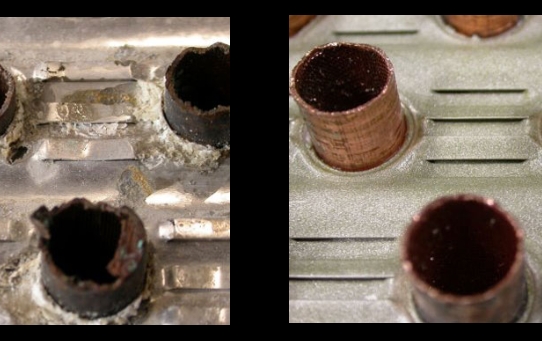
- White, powdery corrosion on aluminium fins
- Dark sticky film on coil faces (hydrocarbon/soot) that “holds” dust
- Rapid rusting of fasteners, coil frames, base pans
- “Tea staining” on stainless in exposed, salt-laden locations
- Increasing condenser approach temperatures or rising head pressures over time
- Coil cleanings that restore performance briefly, then quickly degrade again
Why corrosion matters to performance (not just asset life)
Corrosion drives loss of cooling performance, reduced reliability, reduced energy efficiency, and reduced service life—often with downstream impacts on cost and emissions. At airports this hits harder because systems are often high runtime and high criticality (terminal comfort, baggage systems, plant redundancy planning).
Prevention hierarchy for airport HVAC corrosion
1) Design controls (first line)
- Plant placement: avoid direct apron blast paths; increase stand-off from edges; shield where feasible without starving airflow.
- Air intake positioning: keep OA intakes away from apron exhaust plumes where possible; use filtration strategies appropriate to pollutant load.
- Detailing: avoid ponding, ensure drainage, isolate dissimilar metals, select fasteners compatible with the environment.
- Service access: make coil washing and inspection easy—airport coils need routine cleaning to remove deposits.
2) Maintenance controls (essential)
- Scheduled coil washing appropriate to coating/materials
- Inspection for early fin loss/pitting and casing corrosion
- Water treatment and drift management where towers exist
3) Protective coatings (where Blygold sits)
Coatings are the practical control when you can’t “design away” the environment.
Blygold as a preventative measure (what it is and what it does)
A correctly applied thin-film coil coating aims to:
- Reduce direct chloride contact with aluminium fins (pitting control)
- Reduce under-deposit corrosion by limiting “wetting” and contaminant anchoring
- Improve resistance to acidic pollutant films (NOx/SOx + moisture effects)
- Slow galvanic pathways by separating dissimilar metals from electrolyte exposure
- Maintain thermal performance by controlling film thickness and preserving fin geometry
Where it fits best
- VRF/VRV condensers (thin fins, high exposure, early-life corrosion risk)
- Air-cooled chillers (high replacement cost, long service-life expectations)
- Remote refrigeration condensers (often harsh roof edges, constant operation)
- DX condensers serving critical spaces
- AHU coils exposed to polluted OA and persistent condensate
Implementation notes (what good looks like)
- Use certified applicators and require QA: cleanliness, surface prep, film thickness checks, coverage verification.
- Treat coating as part of a corrosion management plan: placement + washing + inspection + materials compatibility, not a “set and forget.”
Blygold airport links
Blygold coil coating services: https://www.blygold.com/services/coil-coating/
Blygold airport-related project references: https://www.blygold.com/projects/airports/
Closing: the airport corrosion problem in one line
Airport HVAC corrodes quickly because it sits in a high chloride + high pollutant + high cycling atmosphere—functionally similar to high-category Australian corrosivity environments—so Blygold thin-film coil protection plus good detailing and maintenance is the most practical way to protect performance and asset life. airports.pdf