Profile
Why a counter-intuitive problem exists — and where UV-C becomes a precise engineering solution
At first glance, mould growth in cold rooms and freezer rooms feels counter-intuitive.
Cold temperatures are commonly associated with preservation, hygiene, and microbial suppression. Designers, operators, and even auditors often assume that low temperature alone prevents biological growth.
However, real-world cold storage facilities consistently experience mould growth — particularly around:
-
Evaporator coils and drain pans
-
Ceiling joints and corners
-
Door frames and thresholds
-
Behind racking and low-airflow zones
This is not a failure of refrigeration — it is a moisture and physics problem, not a temperature problem.
Modern research confirms that while cold temperatures slow microbial metabolism, they do not eliminate mould viability. Spores survive freezing conditions and become active whenever moisture and nutrients are available.
Cold rooms do not eliminate moisture — they concentrate it.
Why mould occurs in cold and freezer rooms (science, not assumptions)
Mould requires three conditions:
-
Moisture
-
Nutrients
-
A suitable surface
Cold rooms provide all three.
Moisture: condensation is unavoidable
Every door opening introduces warm, humid ambient air. When this air contacts cold surfaces, it crosses the dew point and condenses immediately.
Freezer rooms are particularly vulnerable due to:
-
Freeze–thaw cycling during defrost
-
Ice masking underlying moisture
-
Meltwater migration into joints and materials
Nutrients: operational reality
Cold rooms contain:
-
Cardboard dust
-
Timber pallets
-
Food residues
-
Biofilms on coils and drains
Only microscopic quantities are required.
Temperature: slows growth, does not prevent it
Freezing does not kill mould spores — it preserves them. Growth occurs during:
-
Defrost cycles
-
Shutdown periods
-
Surface wetting events
This is well established in microbiological literature and is why cold storage mould is a known global issue, not an anomaly.
Impacts of mould in cold and freezer rooms
1. Work Health & Safety (WHS)
Mould exposure can lead to:
-
Respiratory irritation
-
Allergic responses
-
Asthma exacerbation
-
Chronic symptoms for staff working daily in enclosed cold environments
Cold rooms are confined, poorly ventilated spaces — exposure concentrations can be high when spores are disturbed.
2. Food safety and product damage
Mould spores can:
-
Contaminate exposed food
-
Settle on packaging and pallets
-
Spread via evaporator air movement
Importantly:
-
Freezing does not neutralise mycotoxins
-
“Dead” spores can still contaminate products
-
Visible mould is an immediate HACCP and audit failure
3. Asset and building degradation
Persistent mould and biofilm lead to:
-
Degradation of door seals and gaskets
-
Odour absorption into insulation facings
-
Reduced evaporator heat transfer
-
Increased defrost frequency and energy use
This becomes a life-cycle cost issue, not just a hygiene issue.
Why UV-C is a niche solution — but an important one
UV-C is not a general-purpose fix for cold room mould. It is a precision tool suited to very specific conditions.
What UV-C does well
UV-C (≈254 nm) damages microbial DNA/RNA, preventing replication. When the correct dose is delivered:
-
Mould growth on irradiated surfaces is suppressed
-
Biofilm formation is reduced
-
Spore viability is significantly lowered
What UV-C does not do
-
It does not remove moisture
-
It does not work through materials
-
It does not work around corners
-
It does not compensate for poor door sealing or vapour control
This is why UV-C should be treated like any other engineered system, not a “plug-and-play” add-on.
The cold-room challenge for UV-C systems
Cold rooms introduce three critical engineering challenges:
1. Lamp output vs temperature
Traditional low-pressure UV-C lamps are temperature sensitive.
In cold environments:
-
Lamp cold-spot temperature shifts
-
UV output can drop significantly
-
Nameplate ratings become meaningless
You cannot assume rated UV output at:
-
+2 °C cold rooms
-
–18 °C freezer rooms
2. High humidity events
UV effectiveness decreases at high RH — exactly the condition present:
-
During door openings
-
During wash-down
-
During defrost
These are also the moments when mould risk is highest.
3. Geometry and shadowing
UV-C is line-of-sight. In cold rooms:
-
Racking blocks coverage
-
Corners trap moisture
-
Ceilings stratify airflow
Blanket “room UV” approaches routinely fail.
Why evaporators are the correct control point
Research and field experience consistently show that evaporators and drain pans are the primary mould reservoirs in cold rooms.
They combine:
-
Moisture
-
Nutrients
-
Air movement (distribution mechanism)
Controlling mould at the evaporator prevents it from being distributed throughout the space.
Australian Ultraviolet’s engineered approach
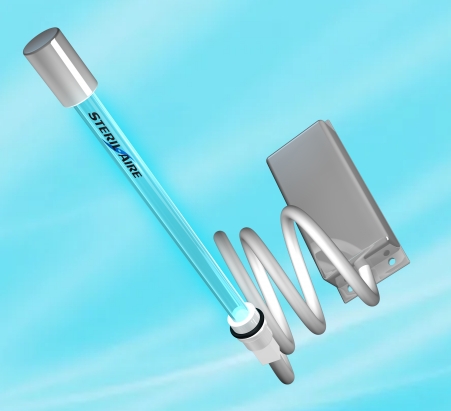
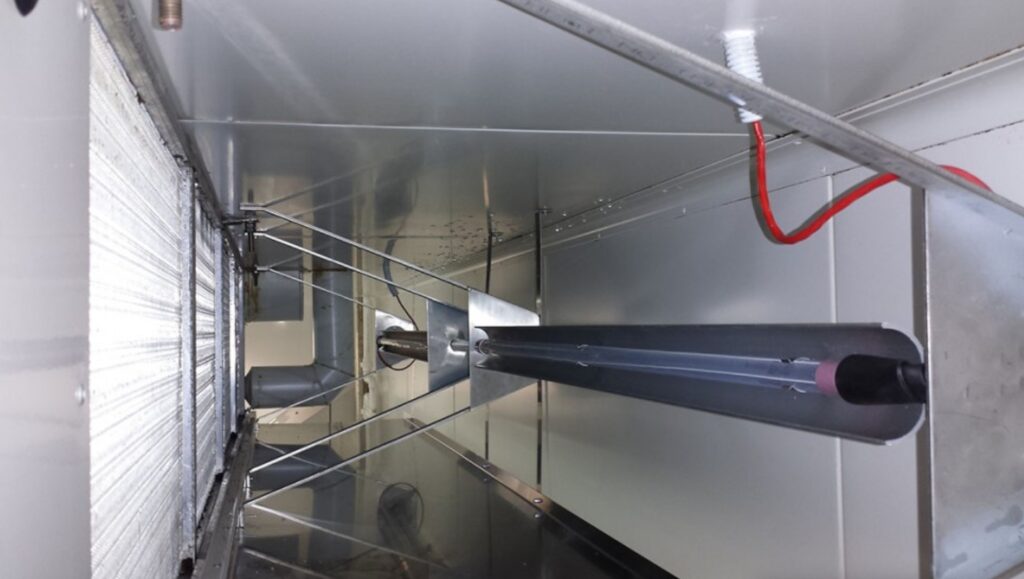
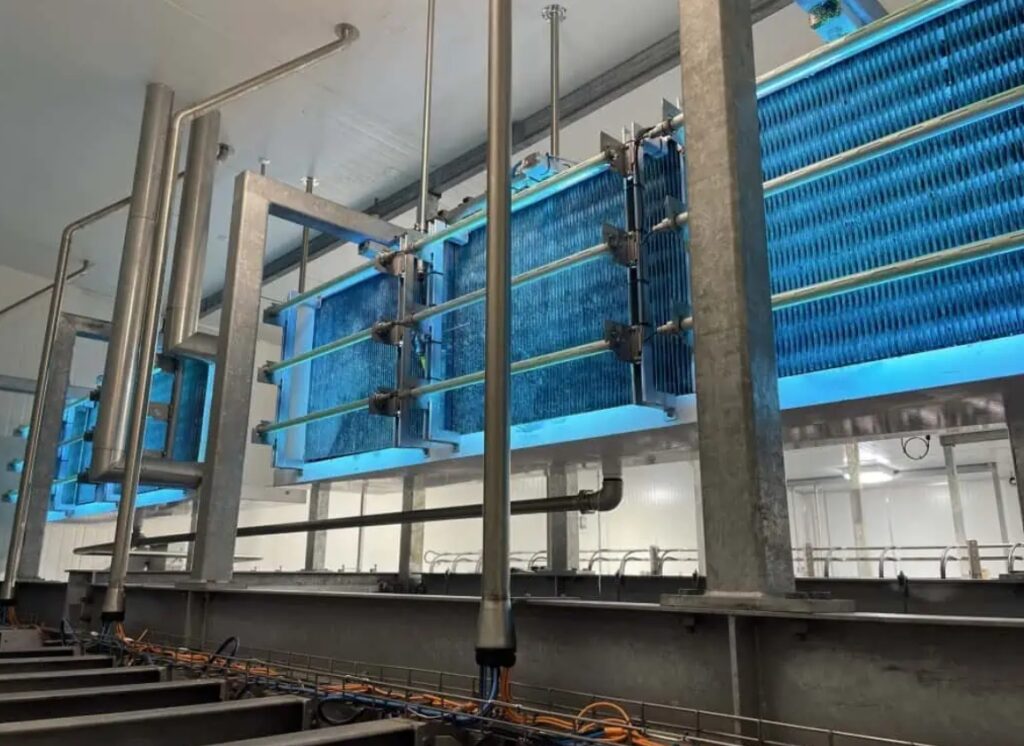
Australian Ultraviolet has focused its research and development specifically on behind-evaporator UV-C systems, recognising that cold rooms require:
-
Controlled lamp temperature
-
Known geometry
-
Continuous prevention, not periodic treatment
Rather than attempting whole-room irradiation, their approach targets:
-
Evaporator coil faces
-
Drain pans and wet surfaces
-
The primary biological source point
This aligns with both microbiological evidence and practical HVAC-R engineering principles.
Design guidance – when their solution is appropriate
Specify behind-evaporator UV-C where all of the following apply:
Repeated mould growth on evaporators or ceilings
Frequent door openings or high humidity ingress
Food or pharmaceutical hygiene risk
Evidence of biofilm or odour persistence
Desire to reduce chemical cleaning frequency
Energy performance degradation linked to fouled coils
It is especially appropriate for:
-
Food processing cold rooms
-
Distribution cold stores
-
Freezer rooms with frequent defrost
-
Facilities with audit exposure (HACCP, BRC, SQF)
What to specify (design intent, not brand slogans)
When specifying behind-evaporator UV-C systems, include:
1. Performance at operating temperature
-
UV output declared at cold room/freezer temperature
-
Not laboratory ambient conditions
2. Geometry-specific design
-
Lamp placement matched to evaporator size and coil depth
-
Full coil face coverage without shadowing
3. Continuous operation strategy
-
Designed for preventative control, not intermittent treatment
-
Integrated with refrigeration operation
4. Safety and access
-
Interlocks or access controls
-
Maintenance procedures suitable for cold environments
5. Defined scope
-
UV-C as a supplementary hygiene control
-
Not a substitute for moisture control, sealing, or cleaning
Key design takeaway
Cold rooms feel clean — but they are biologically active environments.
Mould control is a moisture and physics problem first, and a biological problem second.
UV-C becomes effective only when applied precisely, at the correct location, with systems engineered for cold conditions.
Behind-evaporator UV-C is not a silver bullet — but when correctly specified, it is one of the few tools proven to suppress mould at its source in cold and freezer rooms.
Learn More about Independent testing of Australian Ultraviolet solution for cold and freezer rooms: UVC Gallery – Australian Ultra Violet Pty Ltd.
Reviews
Comments are closed.