Profile
Ultraviolet-C (UV-C), also referred to as Ultraviolet Germicidal Irradiation (UVGI), is increasingly incorporated into HVAC designs to improve indoor air quality (IAQ), suppress microbial growth, and help restore system performance.
Both AIRAH (Australian Institute of Refrigeration, Air Conditioning and Heating) and ASHRAE (American Society of Heating, Refrigerating and Air-Conditioning Engineers) recognise UVGI as a legitimate supplementary engineering control for air and surface disinfection when designed correctly.
-
ASHRAE provides detailed technical guidance on UVGI applications in HVAC systems, including air and surface treatment principles, dose, and system integration:
https://www.ashrae.org/file%20library/technical%20resources/covid-19/i-p_a19_ch62_uvairandsurfacetreatment.pdf -
AIRAH provides practitioner-level guidance on UVGI for HVAC applications, including lamp types, test standards, and practical considerations:
https://www.airah.org.au/Common/Uploaded%20files/Resources/SkillsWorkshop/sw137.pdf
Australian government IAQ guidance also recognises UVGI as a method of microbial inactivation within air systems, particularly for airborne infection control:
https://www.health.vic.gov.au/infectious-diseases-guidelines-and-advice/germicidal-ultraviolet-light-combatting-airborne-virus-transmission
Despite this, UV-C systems are often poorly specified — treated as a generic “lamp in a duct” rather than an engineered system delivering a measurable germicidal dose under real HVAC operating conditions.
This guide provides clear design guidance for engineers, focusing on dose, output, placement, airflow, and temperature, and explains how specialist support can simplify UV-C system design and specification.
1. Start With Design Intent (Not Equipment)
Before selecting equipment, the designer must define what the UV-C system is required to achieve:
-
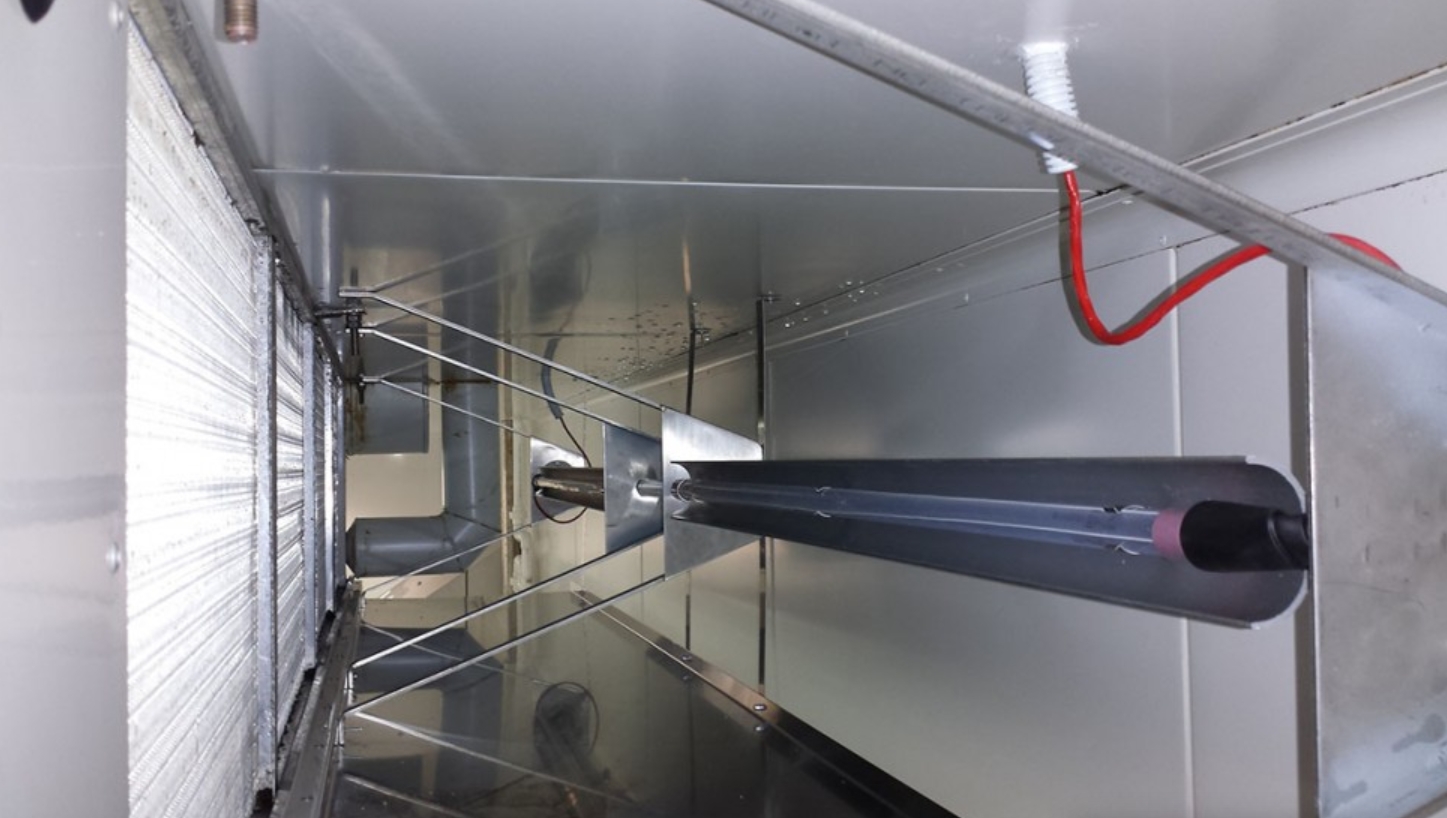
Cooling coil and drain pan irradiation
(biofilm suppression, hygiene, performance restoration) -
In-duct airstream disinfection
(supplementary reduction of airborne microorganisms) -
Odour and microbial control in recirculated air systems
ASHRAE clearly differentiates between air treatment and surface treatment UVGI systems, noting that each has different dose requirements and design approaches.
AIRAH similarly reinforces that UV-C does not replace filtration or ventilation, but complements them.
A clear design intent avoids under-performing or misapplied UV-C installations.
2. UV-C Dose: The Core Engineering Parameter
UV-C effectiveness is governed by dose, not lamp wattage.
UV Dose = Irradiance × Exposure Time
This relationship is fundamental in ASHRAE UVGI guidance and underpins all defensible UV-C design:
https://www.ashrae.org/file%20library/technical%20resources/covid-19/i-p_a19_ch62_uvairandsurfacetreatment.pdf
-
Irradiance depends on lamp output, distance, geometry, reflectivity, airflow, and temperature
-
Exposure time depends on air velocity and the length of the irradiated zone
For coil irradiation, dose is delivered continuously over time.
For airstream disinfection, dose must be delivered in fractions of a second — making airflow conditions critical.
Designs based solely on lamp power or lamp quantity, without reference to delivered dose, are unlikely to perform as intended.
3. Output Must Be Specified at Operating Conditions (The Critical Analogy)
Just as engineers do not specify fans at free air, or cooling capacity without stating air-on / air-off conditions, UV-C systems must not be specified at laboratory conditions alone.
In HVAC design we routinely:
-
Specify fan airflow at a defined static pressure
-
Specify cooling capacity at nominated entering and leaving air conditions
-
Specify chiller capacity at defined water temperatures and flows
UV-C should be treated the same way.
For UV-C systems, output must be specified and assessed at:
-
Actual air temperature at the point of installation
-
Actual air velocity across the lamps
-
End-of-life lamp condition, not just initial output
Specifying UV-C output without velocity and temperature is equivalent to:
-
Specifying a fan without pressure
-
Or a chiller without temperatures
It provides no certainty of real-world performance.
4. Why High-Output Matters in HVAC Applications
Most UV-C lamps are rated under laboratory conditions:
-
Approximately 25 °C air temperature
-
Minimal airflow
-
Beginning-of-life lamp output
HVAC systems typically operate with:
-
Cold air, often ~10 °C downstream of cooling coils
-
High air velocities, commonly around 2 m/s or greater
-
Continuous operation, where end-of-life output governs long-term performance
Under these conditions, output from many conventional UV-C devices falls significantly.
Steril-Aire pioneered high-output UV-C specifically for HVAC systems, and independent testing confirms that Steril-Aire produces up to six times the UV-C output of conventional devices under actual HVAC operating conditions (10 °C air temperature, 2 m/s air velocity) — at end of lamp life.
For engineers, this means:
-
Delivered dose remains aligned with the design basis
-
Performance is not reliant on “new lamp” conditions
-
UV-C effectiveness is predictable and defensible
5. Placement: Geometry Is More Important Than Lamp Quantity
Cooling Coil and Drain Pan Applications
Best-practice placement typically involves:
-
Lamps installed downstream of cooling coils
-
Full line-of-sight coverage of coil fins and drain pans
-
Avoidance of shadowing from frames, sensors, and supports
ASHRAE guidance notes that UVGI applied to wet HVAC surfaces can significantly reduce microbial contamination and biofilm formation:
https://www.ashrae.org/file%20library/technical%20resources/covid-19/i-p_a19_ch62_uvairandsurfacetreatment.pdf
Correct placement:
-
Suppresses biofilm growth
-
Maintains heat-transfer efficiency
-
Reduces coil pressure drop
-
Helps restore design airflow and leaving-air temperature
In-Duct Airstream Applications
For airstream disinfection:
-
Lamps must span the effective duct cross-section
-
Exposure time must be calculated at worst-case airflow
-
Multiple lamp rows may be required at higher velocities
Poor geometry cannot be corrected by simply adding more lamps.
6. Temperature: The Most Commonly Missed Design Variable
Temperature directly affects UV-C lamp output.
ASHRAE notes that UV-C lamp performance can be significantly reduced under cold, high-velocity airflow if systems are not designed for those conditions:
https://www.ashrae.org/file%20library/technical%20resources/covid-19/i-p_s20_ch17.pdf
In HVAC systems:
-
Cold air reduces lamp envelope temperature
-
High airflow creates a wind-chill effect
-
Output from conventional lamps can drop sharply
Steril-Aire systems are engineered and tested to maintain high germicidal output in cold, fast-moving HVAC air, directly addressing this common design failure.
Ignoring temperature effects often results in:
-
Under-delivered dose
-
Poor coil hygiene outcomes
-
No measurable improvement in airflow or thermal performance
7. Alignment With Australian IAQ Guidance
Australian government IAQ guidance, including material published by the Australian Building Codes Board (ABCB) and state health authorities, recognises UVGI as a method using UV-C radiation to inactivate microorganisms in air.
Victorian Department of Health guidance on germicidal UV light:
https://www.health.vic.gov.au/infectious-diseases-guidelines-and-advice/germicidal-ultraviolet-light-combatting-airborne-virus-transmission
This aligns with AIRAH and ASHRAE positions:
-
UV-C is valid when engineered correctly
-
It must be applied alongside compliant ventilation and filtration
-
Performance depends on correct design, installation, and maintenance
8. Simplifying UV-C Design for Projects
Designing UV-C systems requires consideration of:
-
Dose requirements
-
Output at operating temperature and velocity
-
Lamp placement and geometry
-
Maintenance and safety provisions
Rather than re-deriving this for every project, many engineers engage specialist support early to:
-
Validate assumptions
-
Confirm suitability
-
Obtain lamp selections and layouts
-
Reduce design risk and documentation effort
Speak to Steril-Aire Australia
Steril-Aire Australia works directly with consulting engineers to simplify UV-C system design and specification, providing:
-
Application-specific system selection
-
Assistance with dose, placement, and layout
-
Equipment tested and validated for real HVAC operating conditions
-
Support through design, tender, and construction
If you’re considering UV-C on a project — or want to confirm whether it is appropriate — speak to Steril-Aire early. A short technical discussion can save significant design time and help ensure the system delivers measurable IAQ and performance outcomes.
Contact Steril-Aire Australia to help simplify your UV-C design and provide project-specific selections.
Key takeaway for engineers
Specify UV-C like any other HVAC system.
If output isn’t defined at air velocity, temperature, and end-of-life, performance cannot be assured.
Contact Steril-Aire Australia to help simplify your UV-C design and provide project-specific selections.Steril-Aire UVC – HVAC Coil Cleaning, Mould Removal & Indoor Air Quality Solutions Australia
Reviews
Comments are closed.