
Profile
Using Exposed Chilled Water Fan Coil Units in Heritage Buildings
An Engineering Guide to Minimising Structural Disruption, Ductwork, and Penetrations
Designing air conditioning systems for heritage buildings is one of the most constrained and technically sensitive challenges faced by mechanical engineers. Unlike new construction, heritage projects are governed as much by conservation principles as by thermal comfort, energy efficiency, and regulatory compliance.
Large ceiling voids, extensive supply and return air conditioning ducting, air diffusion grilles and major structural penetrations—standard practice in modern HVAC design—are often incompatible with heritage buildings. Ornate plaster ceilings, timber joists, load-bearing masonry walls, and protected architectural finishes leave little tolerance for invasive mechanical services.
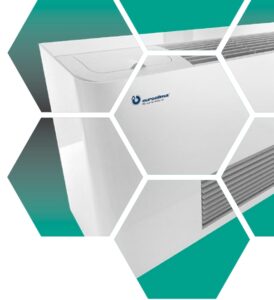
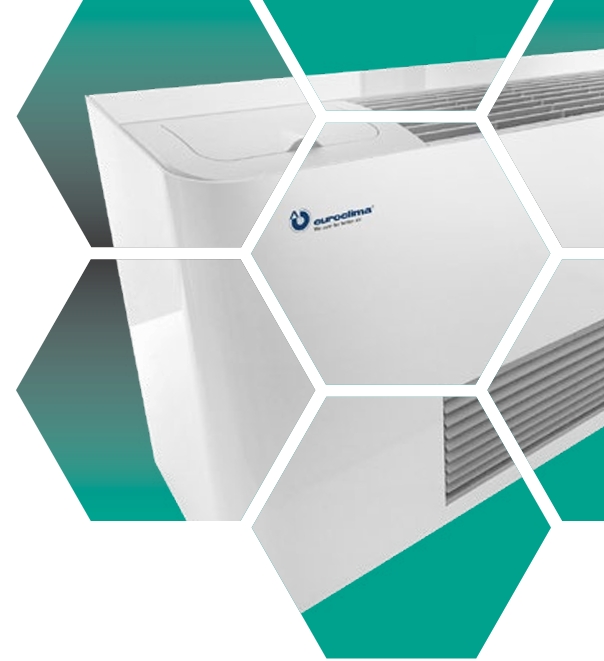
For this reason, exposed fan coil units (FCUs)—including wall-hung, floor-standing, and console-type units—have become a preferred engineering solution. When applied correctly, exposed FCUs supplied by Oceania Solutions Group allow engineers to deliver compliant, controllable, and maintainable air conditioning while dramatically reducing disruption to heritage fabric.
The Core Problem with Ducted HVAC in Heritage Buildings
Traditional ducted air conditioning systems depend on a centralised air distribution strategy:
- Large supply air ducting and ductwork
- Dedicated return air paths/ducts
- Extensive ceiling voids or bulkheads
- Multiple slab, beam, and wall penetrations
- Ceiling mounted air diffusers
In heritage buildings, these requirements frequently conflict with:
- Decorative plaster ceilings and cornices
- Heritage-listed timber ceilings and beams
- Original masonry walls that cannot be core-drilled or altered
- Restrictions on visual and structural changes imposed by heritage authorities
Even when technically feasible, the cost, programme risk, and approval complexity of ducted systems often make them impractical.
Why Exposed FCUs Are Fundamentally Different
Exposed fan coil units shift the system philosophy from air distribution to localised conditioning.
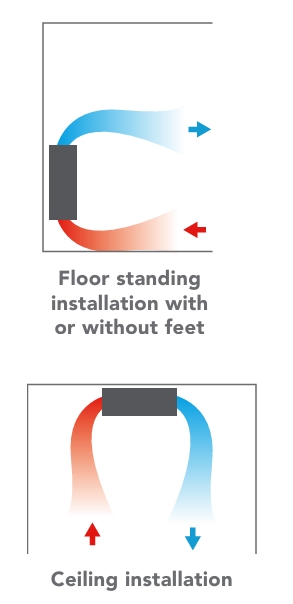
Instead of transporting large volumes of conditioned air throughout the building, cooling and heating are delivered directly for supply of air into the occupied space using chilled water. Air movement is local, controlled, and contained within the room.
Common exposed FCU options include:
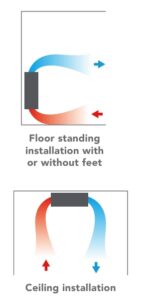
- Wall-hung FCUs mounted high on walls
- Under ceiling FCU’s
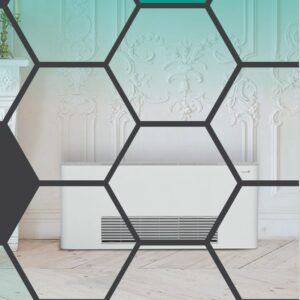
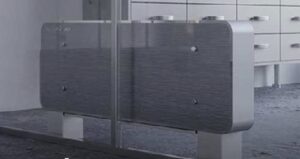
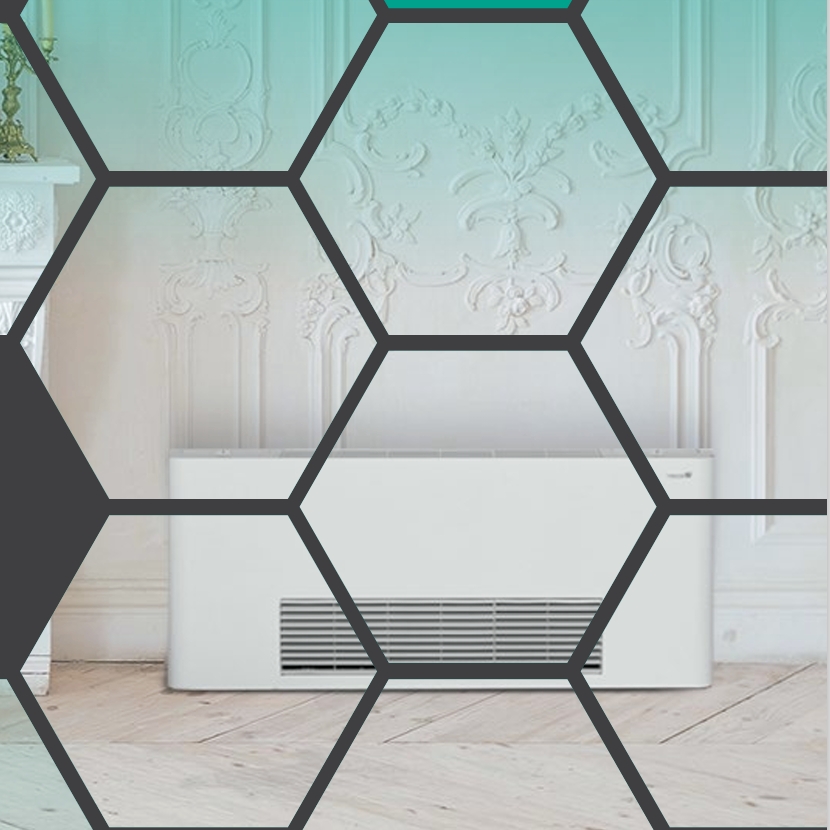
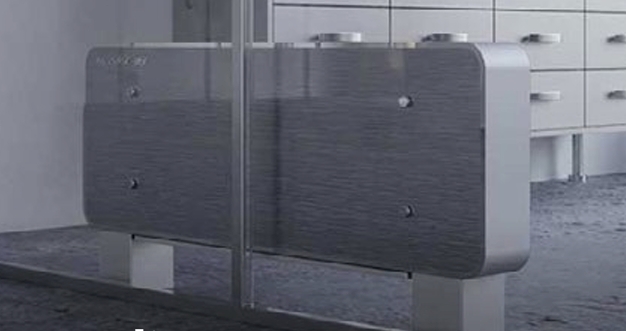
- Floor-standing or console FCUs located below windows or along perimeter walls
- Vertical exposed FCUs suited to narrow or irregular spaces
This approach is particularly effective in heritage retrofits, where space, access, and structural flexibility are limited.
Reduced Disruption to Heritage Ceilings and Walls
One of the most significant advantages of exposed FCUs is the elimination of supply and return air ductwork within occupied spaces.
By removing supply air and return air ducts:
- Heritage ceilings remain untouched
- No bulkheads or false ceilings are required
- Decorative plasterwork, cornices, and ceiling roses are preserved
- Original timber ceilings and joists remain visible and intact
From a conservation perspective, this aligns strongly with heritage principles that prioritise retention of original fabric.
Smaller and Fewer Penetrations
Exposed FCU systems require only:
- Chilled water flow and return pipework
- Condensate drainage
- Control and power cabling
- An outside air duct, where required for either untreated or treated fresh air. Where this becomes difficult you may consider compliance with NCC 5% natural ventilation rule in NCC F6D7 and F6D8 ( borrowed ventilation). Heritage buildings are often likely to meet NCC natural ventilation requirements as they often relied on natural ventilation when originally built.
Compared to ducted systems, these penetrations are significantly smaller, easier to route through existing risers or cupboards, less structurally invasive, and easier to justify and approve under heritage controls.
Flexibility for Irregular Heritage Floorplates
Heritage buildings rarely conform to modern architectural grids. Ceiling heights vary, room sizes are inconsistent, and layouts often evolve through adaptive reuse.
Exposed FCUs provide independent room-by-room temperature control, simple zoning without complex duct balancing, flexibility to suit irregular geometries, and scalability for staged refurbishments.
Reversibility and Conservation Alignment
A key principle in heritage services design is reversibility—the ability to remove or modify interventions in the future without permanent damage.
Exposed FCU systems avoid irreversible structural alterations, can be isolated or upgraded with minimal impact, and leave original building fabric largely intact.
Engineering Design Considerations
Key considerations include acoustics, condensation control, pipework routing, aesthetic integration, and outside air strategy.
Oceania Solutions Group supports engineers with multiple exposed FCU formats and selection guidance to suit heritage constraints.
Conclusion
In heritage buildings, the primary HVAC design challenge is delivering modern performance with minimal impact.
Exposed fan coil units minimise extensive ductwork, minimise penetrations, preserve ceilings and walls, and align with heritage conservation principles.
By adopting exposed FCUs from Oceania Solutions Group, engineers can deliver compliant, maintainable, and flexible HVAC systems while respecting the architectural and historical significance of the building.
Hi Wall CHW FCU: https://www.oceania-group.com/uploads/1/2/7/8/127885727/21015_oceania-euroclima_series_hw_installation_manual_web.pdf
Decorative FCU ( Floor and under ceiling) 21022_oceania_euroclima_decorative_brochure_web.pdf
Reverso 361 Hydronic Aesthetic FCU
21037_osg_reverso_361_brochure_web.pdf
Where ceiling can be disrupted you may consider cassettes
CHW Cassettes: 21014_oceania-euroclima_cassette_cd-cd-ec-double_web.pdf

Reviews
Comments are closed.