Profile
Reducing capital cost, cabling, and commissioning complexity—without compromising comfort outcomes
Why rethink FCU control?
Chilled water fan coil units (FCUs) are widely used across commercial offices, hotels, apartments, healthcare facilities, education buildings, and refurbishment projects. In most cases, the control requirements are relatively straightforward:
-
Maintain space temperature
-
Control fan operation (auto / low / medium / high)
-
Modulate a chilled water control valve (2-way or 3-way)
-
Provide basic scheduling, occupancy setback, and safety interlocks
Despite this, FCUs are often fully integrated into a Building Management System (BMS), resulting in significant cost, cabling, and commissioning overhead that is disproportionate to the functional outcome required at room level.
A Smart Temp thermostat-based FCU control strategy offers a proven alternative—delivering stable comfort control while materially reducing complexity across design, construction, and operation.
Smart Temp thermostats suitable for chilled water FCU applications are readily available in Australia through Controlstore, providing local supply continuity and technical support.
Control philosophy: local intelligence at the terminal unit
Rather than centralising all control logic within the BMS, Smart Temp thermostats place the control intelligence locally at each FCU.
Typical capabilities include:
-
Integral or remote room temperature sensing
-
Local control logic (PID or staged, model dependent)
-
Fan speed switching or EC fan interface
-
Chilled water valve control (on/off or 0–10 V modulating)
-
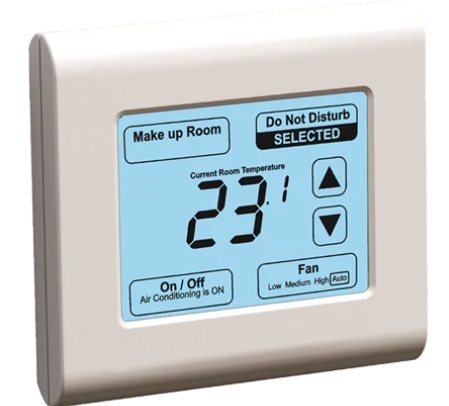
Local user interface for setpoint adjustment, mode selection, and fan control
This approach removes the need to hard-wire multiple signals from every FCU back to a central controls panel, while still achieving predictable and repeatable comfort outcomes.
Installed cost advantages
Reduced BMS hardware and I/O
A fully BMS-controlled FCU typically requires multiple points per unit:
-
Analogue input for room temperature
-
Analogue output for modulating chilled water valves
-
Multiple digital outputs for fan speed control
-
Optional digital inputs for alarms and safeties
When multiplied across dozens or hundreds of FCUs, the cost of controllers, panels, power supplies, networks, and programming becomes substantial.
Using Smart Temp thermostats allows FCUs to operate as standalone terminal units, or with minimal BMS interaction (for example, enable/disable or occupancy input only), significantly reducing:
-
DDC controller quantity
-
Panel size and infrastructure
-
Network cabling and addressing
-
Controls programming and testing scope
Less cabling and containment
From a construction perspective, cabling reduction is often the most tangible saving:
-
Short local wiring runs between thermostat, FCU, and valve actuator
-
Elimination of multi-core home runs to BMS panels
-
Reduced containment congestion in risers and ceiling spaces
-
Lower termination, testing, and fault-finding labour
On refurbishment projects, this reduced cabling scope can materially lower risk to programme and access constraints.
Commissioning advantages
Progressive, independent commissioning
Because control logic is local, FCUs can be commissioned as they are installed and powered—without dependency on:
-
BMS head-end configuration
-
Network completion
-
Graphics development
-
Integration gateways
This enables staged commissioning and reduces late-project pressure at practical completion.
Reduced software risk
Many FCU issues on projects arise from inconsistent or over-customised BMS programming across large unit counts. Smart Temp thermostats rely on standardised, repeatable control logic, resulting in:
-
Fewer variables
-
More predictable site behaviour
-
Easier diagnosis and rectification by commissioning technicians
Clear functional testing and handover
Functional testing is direct and observable:
-
Call for cooling and confirm valve response
-
Verify fan speed operation
-
Confirm setpoint control and deadband
-
Test condensate and safety interlocks
This clarity benefits builders, commissioning agents, and facility managers alike.
Advantages by stakeholder
Advantages for Mechanical Consultants
-
Lower capital cost without compromising comfort outcomes
-
Clear, repeatable control philosophy that is easy to specify
-
Reduced coordination risk between mechanical, electrical, and controls trades
-
Flexibility to offer standalone or hybrid (thermostat + BMS enable) solutions
-
Particularly well suited to refurbishments and fitouts with constrained budgets
Advantages for Mechanical & Controls Contractors
-
Reduced cabling and faster installation
-
Less containment, fewer penetrations, and simpler wiring layouts
-
Ability to commission FCUs progressively, independent of BMS readiness
-
Reduced defects and rework associated with complex software integration
-
Local product availability and technical support via Controlstore
Advantages for Facility Managers & Building Owners
-
Simple, intuitive local control at each FCU
-
Reduced reliance on BMS access for day-to-day comfort adjustments
-
Lower ongoing maintenance and software support burden
-
Improved resilience—failure of one thermostat affects only one space
-
Clear demarcation of responsibility for FCU performance
Where this approach fits best
Smart Temp thermostat-based FCU control is particularly effective for:
-
Commercial refurbishments
-
Tenancy fitouts
-
Hotels and residential buildings
-
Small to mid-scale commercial projects
-
Sites where the BMS is focused on central plant rather than terminal units
Smart Temp thermostats and associated accessories for these applications are supplied locally through Controlstore, ensuring continuity of supply and Australian technical support.
When full BMS control may still be appropriate
A fully integrated BMS solution may be justified where projects require:
-
Advanced energy analytics and optimisation
-
Extensive trending and fault diagnostics
-
Tight integration with other building systems
-
Corporate or portfolio-wide BMS standards
In such cases, a hybrid approach is often effective—Smart Temp thermostats manage local comfort control, while the BMS provides high-level enable, scheduling, or monitoring functions.
Practical design considerations
-
Confirm valve control strategy early (on/off vs modulating)
-
Match thermostat capability to fan type (PSC vs EC)
-
Pay close attention to room sensor placement
-
Address condensation risk where low chilled water temperatures are used
-
Define user access limits to protect post-handover setpoints
Controlstore can assist designers and contractors in selecting appropriate Smart Temp models and configurations to suit each application.
Conclusion
For chilled water fan coil unit projects where cost certainty, constructability, and commissioning efficiency matter, Smart Temp thermostat-based control provides a robust and low-risk alternative to full BMS integration. With local availability and technical support through Controlstore, this approach delivers clear value across design, construction, and ongoing operation—without compromising comfort performance.
Learn more: Smart Temp SMT-770 (Chameleon) multi function thermostat Heat/ Cool or – ControlStore
Reviews
Comments are closed.