Profile
Psychrometrics is one of those core HVAC skills that quietly underpins everything—coil selections, moisture control, comfort, condensation risk, and whether your load model actually makes physical sense. Yet it’s also one of the most commonly “outsourced” parts of design thinking to software outputs.
That’s why MEP Engineering Co has published a free, practical training session on Psychrometrics for consulting eng
ineers, mechanical contractors, and commissioning technicians—focused on how to interpret and use the psychrometric chart the way it was intended: as a design and checking tool.
If you’re designing anything beyond basic comfort cooling—labs, museums, art galleries, process facilitie
s, data centres, comms rooms, or high-ventilation classrooms—Psychrometrics stops being optional.
What this free training covers
MEP Engineering Co’s session walks through the chart in a way that connects directly to how HVAC systems behave:
1) The key chart “languages” engineers must read fluently
– Dry bulb (DB) and wet bulb (WB) lines (and why WB and enthalpy are almost parallel)
– Relative humidity (RH) curves and the saturation line
– Moisture content / humidity ratio (W) and why grams/kg matters in latent calculations
– Specific volume and what it implies about density and airflow assumptions
– Sensible Heat Factor (SHF) and why it influences process slope
2) Mixed air and “coil entering” conditions
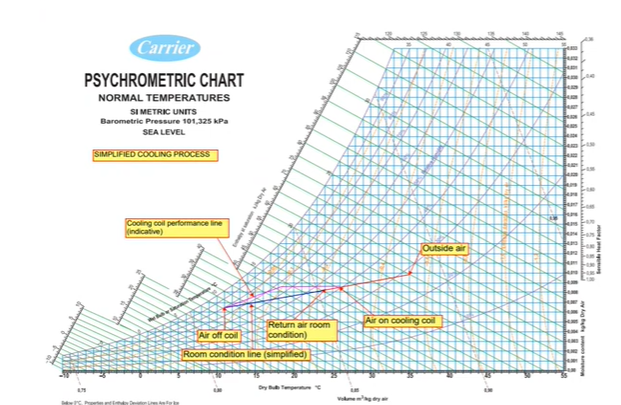
A very common design step—mixing return air and outside air—is shown as a straight line between tw
o state points on the psych chart. The training explains how that mixed air point represents your coil entering condition and why it’s critical for:
– coil capacity checks
– air-off temperature feasibility
– latent load control under high OA fractions
3) Apparatus dew point and condensation logic (the physics behind the coil)
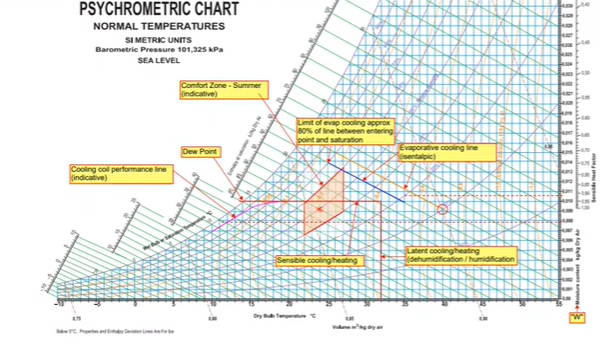
The session reinforces what dew point actually means: the temperature at which air becomes saturated at the same moisture content. This is the backbone of:
– why cooling coils dehumidify
– why humid climates create persistent condensation risk
– why cold surface meets high dew point air is the real trigger condition engineers should be checking
4) Coil air-off reality: bypass factor and why you don’t hit 100% saturation
A strong practical point for designers and contractors: in real coils, air doesn’t perfectly contact cold surfaces. So air-off is typically ~90–95% RH, not 100%. The training connects this to:
– coil bypass factor
– coil construction (fin density, rows, face velocity, circuiting)
– interpreting manufacturer selections vs load model assumptions
5) Sensible vs latent equations you’ll actually use
The session anchors the key “back-of-envelope” checks:
– Sensible heat: proportional to airflow × ΔT
– Latent heat: proportional to airflow × ΔW (humidity ratio change)
These aren’t just academic—these are the calculations that help you sanity-check software outputs, co
mmissioning data, and design intent.
6) Understanding “air-off point” logic (and why it’s not arbitrary)
A common question answered in the training: “How do you know where the air-off point is on the 90% RH line?”
The answer isn’t guessing—it’s tied to:
– the ratio of sensible to total heat (i.e., SHF)
– the process line slope
– the relationship between room conditions, coil process, and apparatus dew point concepts
Bonus: evaporative cooling Psychrometrics explained properly (and when it’s worth considering)
The training also covers evaporative cooling as a psychrometric process—useful for engineers working across varied Australian climates.
It explains:
– evaporative cooling is approximately constant enthalpy / constant wet bulb
– why it performs well in hot-dry climates
– why it performs poorly in humid climates
– practical considerations like relief air paths and avoiding humidity build-up
Who should watch this training?
– Consulting engineers wanting to better interpret load model outputs and coil selections
– Mechanical contractors dealing with air balancing, coil performance, and site troubleshooting
– Commissioning technicians verifying air-off conditions and latent control
The real takeaway
Psychrometrics isn’t a “nice-to-have” skill. It’s the framework that links heat loads, air conditions, coil performance, and delivered comfort and humidity control.
Watch the free MEP Engineering Co Psychrometrics training video to upskill today https://youtu.be/I3WEV42RR1s?si=EE7lc84gN0rzzWCa
Reviews
Comments are closed.