Profile
1) Ventilation Design in Australia – The AS 1668.2 Foundation
In Australia, most HVAC and ventilation systems are designed using litres per second per square metre (L/s·m²), as outlined in AS 1668.2 – The Use of Ventilation and Airconditioning in Buildings.
This method provides a consistent approach for determining minimum outdoor air rates, ensuring compliance, occupant health, and comfort across most commercial and residential applications.
However, there are several specialised situations where air change rates (ACH) are the more appropriate or even the required design method and needs to also be considered. Quite often As1668.2 will dictate minimum code requirements and Air Change rates will dictate best practices and both should be considered in special applications.
-
Applications Where Air Change Rates Are Used
While AS 1668.2 governs general ventilation design, air change rates are crucial in a range of critical and industrial applications.
-
a) Controlled and Clean Environments
Air change rates are essential for cleanrooms, laboratories, and pharmaceutical manufacturing.
Typical examples include:
- PC2 and PC3 laboratories
- ISO cleanrooms
- Pharmaceutical processing areas
In these cases, ACH is linked directly to contaminant control, cleanliness classification, and process stability.
-
b) Pressure-Controlled and Isolation Rooms
In quarantine facilities, containment labs, and hospital isolation rooms, air change rates support pressure differentials between spaces.
They ensure directional airflow is maintained, preventing cross-contamination and meeting infection control or biosecurity requirements.
-
c) Industrial and Process Ventilation
In abattoirs, food handling plants, and chemical processing areas, air change rates are used to manage odours, airborne contaminants, and internal heat loads.
Designers often combine mechanical extraction systems with make-up air units, using ACH values to verify ventilation effectiveness.
-
d) Air Filtration and Recirculating Systems
When applying recirculating air filtration—rather than outdoor air supply—air change rates measure how frequently the entire air volume of a space is filtered.
This metric is particularly valuable in:
- Retrofit air cleaning upgrades
- Portable HEPA and UV filtration units
- Using the Japan Air Filter Air Change Rate Calculator
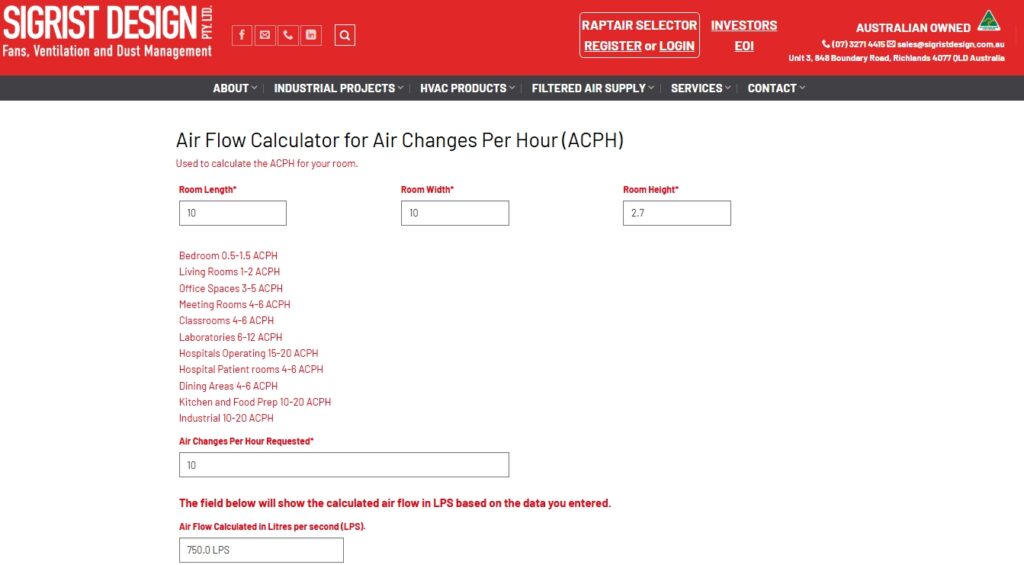
Air Changes per Hour Calculator – Sigrist Design
The Air Changes per Hour (ACH) Calculator from Sigrist Design is a practical online tool that helps engineers, contractors, and facility managers estimate ventilation performance within a room or building. By relating airflow rates to room volume, the calculator quickly determines how many times the air in a space is replaced each hour—an important metric for indoor air quality and HVAC system design.
The tool is supported by guidance on recommended ACH values for common building spaces, helping users understand whether a ventilation system is likely to meet practical air-quality expectations.
For HVAC designers, these reference values make the calculator useful during concept design, ventilation assessments, and equipment selection, providing a quick way to check whether proposed airflow rates will achieve suitable air exchange for the intended space.
Engineering Innovation at Sigrist Design
At Sigrist Design, innovation in HVAC engineering is driven by a simple principle: listen to the people who actually install, specify, and operate ventilation equipment. Feedback from mechanical engineers, contractors, installers, and building owners directly influences how their fans and ventilation systems are designed and manufactured.
Rather than relying on decades-old fan designs, Sigrist focuses on practical engineering improvements that reduce installation time, simplify handling on site, and improve the overall outcome of a ventilation system. Their approach prioritises the total project solution rather than just the individual product price.
Many of these innovations are simple but highly practical. Examples include:
-
Roof fans designed to be forklifted directly to trucks without pallets, reducing handling and waste.
-
Integrated lift points that allow fans to be hoisted directly onto roofs.
-
Flat-edge flanges that prevent equipment rolling on site during installation.
-
Modular fan designs enabling faster manufacturing and flexibility for custom orders.
-
Multiple component sourcing strategies to reduce supply-chain delays.
This design philosophy extends across Sigrist’s ventilation product range, including axial, centrifugal and mixed-flow fans, roof cowls, silencers, and dust-collection systems, which are engineered and manufactured in Australia for commercial and industrial applications.
By focusing on ease of installation, reduced labour time, and real-world engineering practicality, Sigrist Design aims to deliver solutions that are more valuable than simply competing on product price.
Investment Opportunity
Sigrist Design is now inviting investors to participate in the next stage of its growth as an Australian manufacturer of innovative HVAC and industrial ventilation systems. For those who recognise the value of locally engineered solutions, responsive manufacturing, and customer-driven product innovation, this represents an opportunity to support a business that continues to evolve its technology and capabilities.
Learn more about the investment opportunity or register your interest through the Sigrist Design investor enquiry page.
Reviews
Comments are closed.