Profile
Designing Enthalpy Heat Wheels for High Outside-Air Multi‑Storey Schools & Universities
Multi-storey education buildings are “outside-air dominated” more often than designers expect. High occupant density, long operating hours, intermittent zone usage (lecture theatres, labs, gyms), and strict indoor air quality requirements mean that the outside air (OA) coil load—particularly latent load—can dominate system capacity. An enthalpy (total energy) heat recovery wheel is one of the most effective ways to reduce this OA burden, provided it is designed as part of a complete ventilation system rather than added as a nominal energy recovery component.
This document provides technical guidance for engineers designing enthalpy heat recovery wheels for outside-air supply systems serving multi-storey schools and universities where outside air loads are high and operational patterns vary significantly.
-
System schematic design – applying the heat wheel where it delivers the greatest benefit
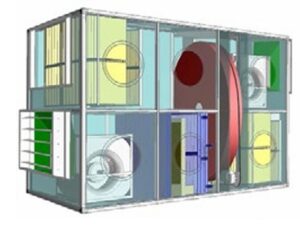
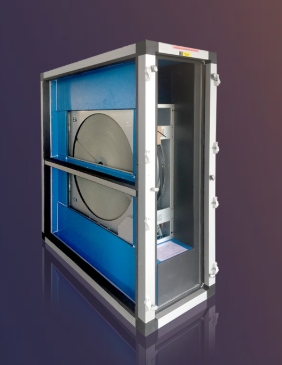
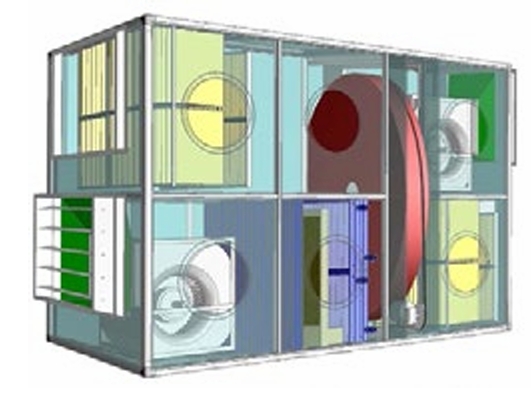
Enthalpy heat recovery wheels should be located so that they pre-condition all incoming outside air using exhaust air energy. A typical arrangement consists of a central outside-air or DOAS-type air handling unit incorporating a heat recovery wheel between the outside air intake and the exhaust air discharge. Exhaust air from each level is returned via exhaust risers to the heat wheel. As an option downstream of the wheel, cooling and heating coils could be used provide final trim to meet supply air conditions before air is distributed via risers to each level.
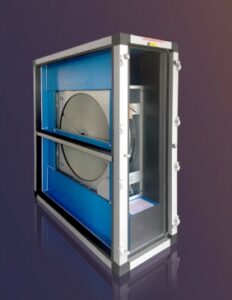
This configuration ensures that both sensible and latent loads associated with outside air are reduced before reaching terminal equipment. By lowering entering air enthalpy, the downstream cooling coil duty is reduced and the need for reheat is minimised. G.J. Walker heat recovery wheel modules are suited to this approach, with options for sensible or enthalpy media, integrated filtration, and downstream heating and cooling coils.
-
Zoning strategy – dampers on supply and exhaust to every level or functional area
A critical requirement in multi-storey education buildings is the ability to isolate ventilation to areas that are not in use. For this reason, each level or major functional area should be provided with motorised dampers on both the supply air and the exhaust (or return) air.
This arrangement allows individual floors or zones to be fully shut down outside of scheduled occupancy while maintaining correct system balance. Supplying air to a zone without a corresponding exhaust path, or vice versa, leads to wasted energy, pressurisation problems, and degraded heat wheel effectiveness. Dampers should be interlocked via the building management system so that supply and exhaust operate together, except under defined fault or purge conditions. Dampers should also be interlocked with the Air Handling units ( AHUs) with a flow switch and appropriate controls & systems. Where demand control ventilation is used with a co2 probe care must be taken during commissioning to ensure Exhaust is balanced with supply of air to FCUs / AHUs.
-
Fan control strategy – Variable Speed Drive / EC fans with constant duct static pressure control
As floors and zones are enabled and disabled, the ventilation system must respond smoothly to changes in airflow demand. Variable speed drives (or EC fans) should be provided on both supply and exhaust fans, with constant duct static pressure control (using a pressure sensor) used to maintain stable airflow delivery.
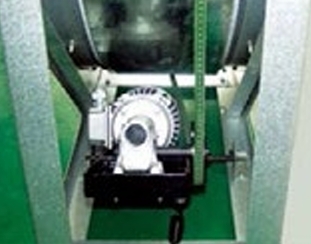
Static pressure sensors should be located to represent the critical path of the system, typically near the top of the supply and exhaust risers. This strategy ensures that when dampers open or close, fan speed adjusts automatically to maintain required airflow without excessive noise, instability, or energy use. G.J. Walker heat recovery wheel systems can be supplied with EC or AC plug fans, which are well suited to variable speed operation in this type of application.
-
Maintaining supply and exhaust balance for maximum heat wheel efficiency
Heat recovery wheels operate most efficiently when the supply airflow and exhaust airflow through the wheel are closely matched. Significant imbalance reduces both sensible and latent recovery effectiveness and increases the risk of exhaust air carryover into the supply air stream.
In multi-storey education buildings with variable occupancy, airflow balance should be treated as an active control objective rather than a static commissioning outcome. This can be achieved using airflow measurement stations on supply and exhaust, with fan speed control used to maintain a defined flow ratio. Alternatively, static pressure control can be supplemented with airflow trim logic to maintain balance across the wheel.
Correct pressure relationships across the wheel also help minimise leakage and carryover. Where provided, purge sectors and appropriate pressure offsets should be incorporated into the design and control philosophy.
-
Reducing downstream FCU load and managing latent conditions
One of the most important benefits of enthalpy heat recovery in schools and universities is the reduction of latent load seen by room-level equipment. By transferring moisture from the incoming outside air to the exhaust air stream, the wheel lowers the moisture content of supply air before it reaches occupied spaces.
This reduces the latent cooling duty on fan coil units and other terminal devices, allowing them to operate more consistently in sensible cooling mode. The result is improved humidity control, reduced risk of condensation and microbial growth, and lower reliance on reheat to maintain space conditions. These benefits are particularly valuable in high-density classrooms and lecture theatres where occupancy-driven moisture loads fluctuate rapidly.
-
Economy cycle operation – bypassing heat recovery when ambient conditions are favourable
Heat recovery should not operate continuously. During periods when outdoor air conditions are favourable, such as mild or cool weather, the system should take advantage of free cooling rather than recovering energy unnecessarily.
An economy cycle or wheel bypass arrangement should be incorporated so that when outdoor air enthalpy (using a temperature and humidity sensor) is lower than return air enthalpy and can meet supply air requirements directly, the wheel is bypassed or stopped. G.J. Walker heat recovery wheel systems can be provided with bypass sections specifically for this purpose, enabling clean changeover between heat recovery and economiser operation.
-
Selecting enthalpy media – maximum benefit with appropriate risk management
Enthalpy wheels use desiccant-coated media to transfer both heat and moisture between air streams. This provides maximum capacity and energy savings in humid climates and high outside-air applications typical of education buildings.
However, enthalpy wheels should not be applied indiscriminately. Where exhaust air contains contaminants that cannot be tolerated in the supply air, even at very low carryover rates, alternative strategies should be considered. In such cases, sensible-only wheels or other heat recovery technologies may be more appropriate. G.J. Walker offers both sensible and enthalpy wheel options, allowing the designer to match the recovery method to the risk profile of each application.
-
Applying G.J. Walker heat recovery wheel features in education projects
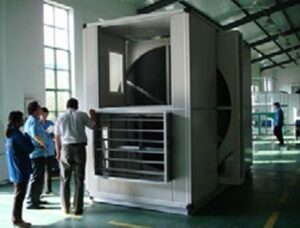
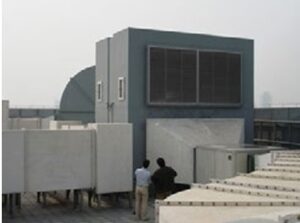
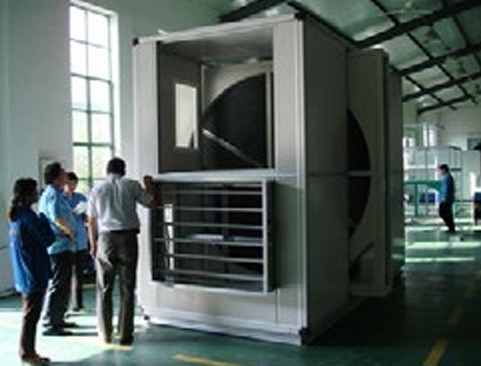
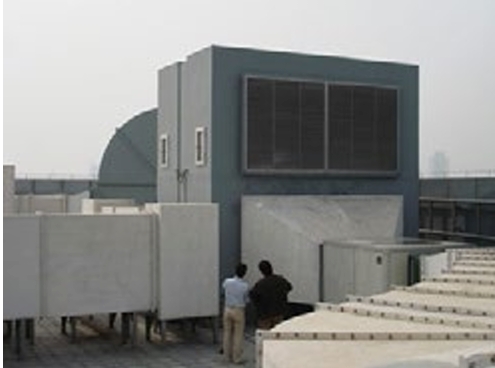
G.J. Walker heat recovery wheels offer several features that align well with the demands of multi-storey schools and universities. Double-skin insulated casings improve thermal performance and reduce condensation risk in rooftop and external installations. Optional stainless steel internal linings and corrosion-resistant wheel options support applications in humid or aggressive environments, such as aquatic centres on campus.
Integrated fan options, filtration, and coil selections allow the heat recovery wheel to be configured as part of a robust outside-air handling solution. The availability of wheel bypass sections supports proper economy cycle control, while certified performance data assists engineers in energy modelling and compliance documentation.
For projects with space constraints, compact energy recovery unit configurations are available and are suitable for high-occupancy, space-limited education buildings.
-
Commissioning and specification considerations
To ensure that the intended performance is achieved in practice, specifications should require verification of airflow balance across the wheel at minimum, typical, and peak operating conditions. Economy cycle and bypass operation should be demonstrated, and correct damper interlocking confirmed for all zones. Fan control stability should be tested under step changes in zone demand.
Conclusion
When properly designed and controlled, enthalpy heat recovery wheels provide substantial benefits in multi-storey schools and universities with high outside air loads. By reducing both sensible and latent outside air loads, they improve system efficiency, enhance humidity control, and reduce the burden on downstream equipment. G.J. Walker heat recovery wheels offer the configurability, performance, and robustness required to implement these strategies effectively in complex education environments.
Find out more: Heat Recovery — GJ Walker

Reviews
Comments are closed.